
EBL 2400W Portable Power Station
4.4Editor score
1,843.2Wh battery capacity
2,400W maximum output
Twelve-device simultaneous charging
Discover the best portable power station for Cpap, with 10 models compared for runtime, UPS support, power output, capacity, portability, charging, and safety.
A portable power station can keep a CPAP machine running during outages, camping trips, travel, or other situations where conventional electricity is unavailable. A useful model needs enough stored energy for the night, compatible AC output, a dependable backup-power mode, and enough charging flexibility for your planned use.
This guide compares ten power stations using capacity, continuous and surge output, UPS transfer behavior, port selection, charging methods, battery chemistry, weight, and intended applications. It includes compact options for CPAP-only setups, larger systems for extended outages, and home-backup models with greater expansion potential.
Each review shows which use case the product best addresses, along with practical limitations to consider before buying. Ratings and product details reflect the supplied listings, while pricing, availability, and promotional terms can change, so readers should confirm current information before making a purchase.
4.4Editor score

4.8Editor score

4.7Editor score
The comparison below highlights the key differences among ten portable power stations suitable for CPAP use. Capacity, output, transfer speed, charging flexibility, and portability help distinguish a lightweight travel unit from a larger home-backup system.



The Jackery Explorer 1000 v2 combines a 1,070Wh battery with 1,500W of continuous AC output in a 23.8-pound enclosure. It carries a 4.8 rating, and its combination of capacity, manageable weight, pure sine wave AC ports, and app-based operating modes makes it an especially balanced choice for CPAP users. It is large enough for useful reserve capacity without moving into the weight and footprint of a home backup system.
We may earn a commission when you buy through this link, at no additional cost to you.
Three pure sine wave AC outlets provide more flexibility than a single-socket unit, while two USB-C ports, one USB-A port, and a DC car outlet support phones, tablets, lights, and other accessories. The 100W USB-C connection can charge compatible devices rapidly without a separate adapter. A 30dB quiet charging mode is particularly useful beside a bed, and the app also provides energy-efficiency and emergency charging controls.
The main trade-off is solar flexibility. Jackery states that the Explorer 1000 v2 is compatible only with Jackery solar panels, and the supplied package does not include a panel. Fast charging can reach a full charge in one hour when emergency charging is enabled, although the normal app-controlled setting takes 1.7 hours to optimize battery health. Buyers who need compatibility with a wider selection of third-party solar equipment should verify the current panel requirements before ordering.
This is the most versatile all-around recommendation in the guide for travelers, campers, and households preparing for outages. The 1,070Wh capacity offers comfortable margin for overnight CPAP operation and selected accessories, while the pure sine wave output is useful for sensitive electronics. Choose it when balanced portability, output, useful controls, and low noise matter more than universal solar-panel compatibility or a very high power ceiling.
With 1,070Wh available, the Explorer 1000 v2 provides room for overnight CPAP use plus a margin for a phone, lamp, or other essential device. The pure sine wave AC output is well suited to modern CPAP systems and their associated electronics, provided the device's power requirements are verified before use.
The 30dB overnight charging mode reduces distraction during sleep, while app controls let users select charging speeds and energy modes. The one-hour emergency option is useful before a trip or outage, though the default 1.7-hour setting is designed to favor long-term battery health.
We may earn a commission when you buy through this link, at no additional cost to you.
The UDPOWER S1200 stands out for its claimed UPS transfer time of less than 0.01 seconds, one of the fastest responses in this comparison. It pairs that feature with a 1,190Wh battery, 1,800W pure sine wave output, and 14 ports. Its 4.1 rating is lower than those of the leading products, but the technical focus on immediate backup power is highly relevant when a CPAP device must continue operating through a sudden outage.
We may earn a commission when you buy through this link, at no additional cost to you.
The connection mix is unusually broad: five AC outlets, two 100W USB-C ports, four USB-A ports, a car outlet, and two DC5521 connections. That allows a CPAP machine, router, lighting, and several small electronics to operate at the same time. Voltage control and load balancing are also listed as protections for sensitive electronics. For users who need rapid transfer and many connections rather than one highly integrated product, this specification set is compelling.
The listing includes a 120W folding solar panel, but the station and panel ship separately. The panel is IP65 rated, measures 34.4 by 31.5 inches, and uses an adjustable stand. The station uses LiFePO4 cells rated for more than 4,000 cycles while retaining 80% of capacity, according to the listing. A potential drawback is the relatively modest 4.1 customer rating, which may make the fast UPS claim and overall build quality worth checking through current customer feedback.
The S1200 is a strong candidate for CPAP users who prioritize near-instant changeover, a generous port count, and solar recharging in one broader ecosystem. It is also sensible for a travel or camping setup where a CPAP machine and multiple accessories need power. Buyers should account for the separate panel shipment and verify the UPS compatibility of their exact CPAP and connected equipment before relying on the backup function.
The listed UPS response of under 0.01 seconds is designed to minimize interruption when mains power fails. This is a meaningful distinction for sensitive equipment, although users should still test their exact CPAP setup and any required accessories with the station in UPS mode.
The separately shipped 120W panel has an IP65 rating and an adjustable stand for outdoor use. Because it is not protected in the same box as the station, buyers should consider the separate components when planning a compact travel kit.
We may earn a commission when you buy through this link, at no additional cost to you.
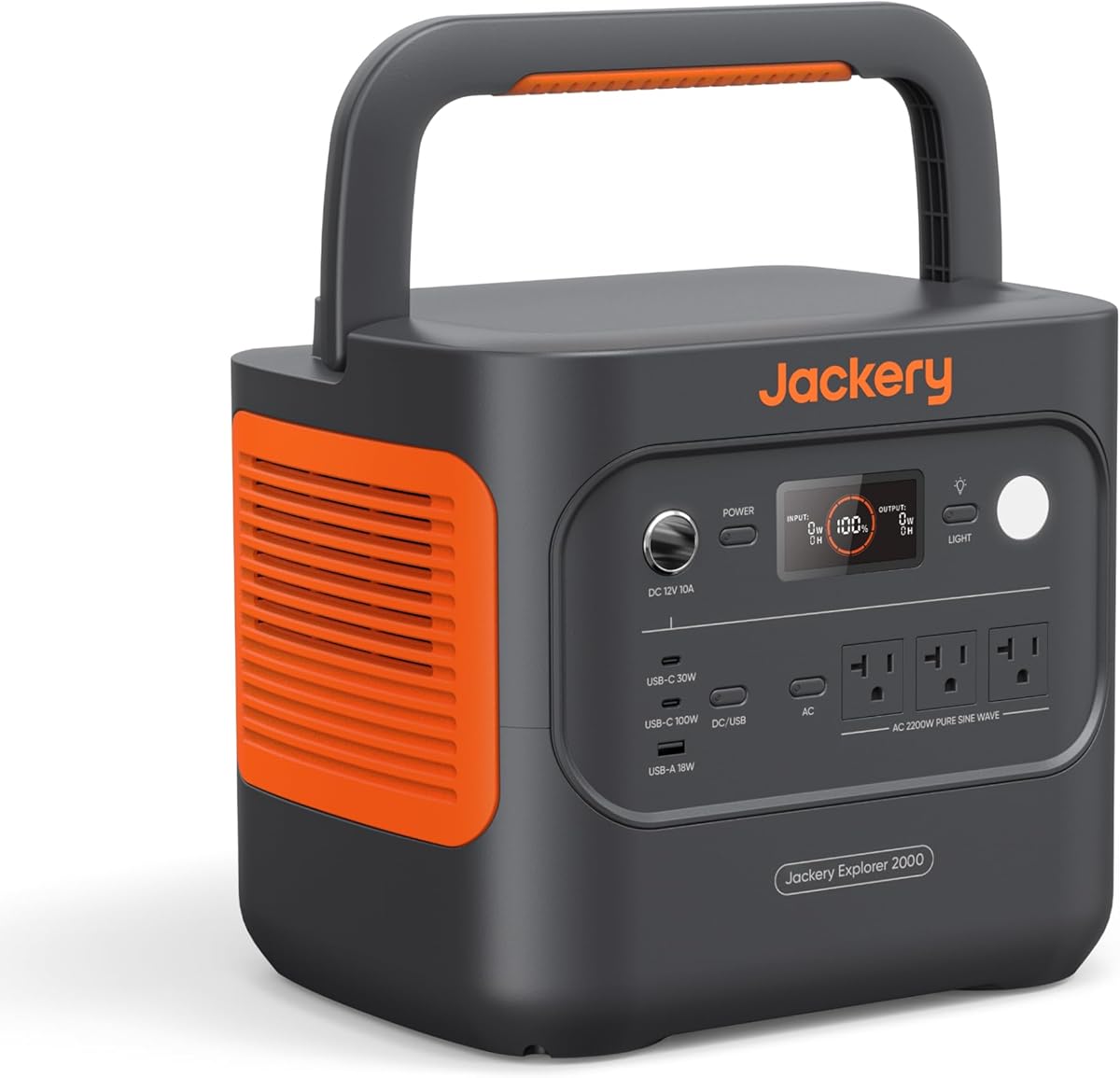
The Jackery Explorer 2000 v2 offers 2,042Wh of capacity, nearly twice the storage of the Explorer 1000 v2, while retaining a manageable listed weight of 39.5 pounds. It has a 4.4 rating, 2,200W of continuous AC output, and a 20ms UPS response. Those characteristics make it a natural fit for CPAP users who need more than one night's reserve or want to keep essential household devices running alongside respiratory equipment.
We may earn a commission when you buy through this link, at no additional cost to you.
Three AC outputs provide additional connection options, and a 100W USB-C port handles compatible electronics without an adapter. Fast AC charging can reach 80% in 66 minutes, while emergency super charging through the app can complete a recharge in 102 minutes. Solar charging can take as little as six hours with 400W panels. Silent charging mode operates below 30dB, making the unit more practical beside a sleeping area.
Its 39.5-pound weight is the principal compromise for travel. The unit is considerably less convenient to carry than the 14.3-pound AFERIY Nomad800 or the 23.8-pound Explorer 1000 v2, and no solar panel is included. Although the product is designed as a portable system, it is better suited to vehicle trunks, campsites reached by car, or stationary home use than lightweight backpacking. Jackery also states that a PowerBox battery is required for this model.
Choose the Explorer 2000 v2 when your priority is generous reserve capacity and quiet operation during extended outages. It is a strong middle ground between compact travel stations and very large home systems. Buyers should confirm their required solar-panel configuration and keep the 20ms UPS behavior in mind when evaluating whether it suits their CPAP equipment.
The 2,042Wh battery offers a comfortable reserve for overnight CPAP operation, backup lighting, communications, and selected household electronics. It reduces the need to recharge every day during a prolonged outage, though actual runtime depends on the CPAP settings, mask equipment, and other connected loads.
AC fast charging can restore 80% in 66 minutes, and silent charging remains below 30dB. These features are valuable in a bedroom or quiet recovery space where fan noise could otherwise make the station less comfortable to operate overnight.
We may earn a commission when you buy through this link, at no additional cost to you.
The AFERIY Nomad800 is the lightest option listed, weighing 14.3 pounds, and its product title explicitly identifies CPAP use as a target application. It offers 512Wh of capacity, 800W continuous output, 1,600W peak output, pure sine wave power, and a 10ms UPS response. Its 4.0 rating is the lowest in the group, but the combination of weight and backup capability is attractive for travel-focused buyers.
We may earn a commission when you buy through this link, at no additional cost to you.
Eight connection options include one AC outlet, two USB QC3.0 ports, three Type-C ports, a DC5521 connection, and a car outlet. The product supports charging through AC, solar, or a 12V car socket, while a bidirectional inverter accepts up to 400W of input. An LCD display presents operating information, and the LED light offers lighting, SOS, and flashing modes, which are useful around a campsite or during an outage.
The 512Wh battery is the key limitation. It is best suited to a CPAP-only load and perhaps a phone or small light rather than a collection of household appliances. Solar input is capped at 200W, and the included cable and repair card form a more compact package than larger systems. For users who require extended runtime or simultaneous high-power equipment, the larger-capacity options in this guide are more appropriate.
The Nomad800 is a persuasive choice for light packers, travelers, and campers who prioritize low weight more than long runtime. Its pure sine wave output, 10ms UPS, and three Type-C ports make it practical for modern travel electronics. Confirm the energy needs of the exact CPAP system, and test the full setup before relying on it during an extended emergency.
At 14.3 pounds, the Nomad800 is easier to transport than most units in the guide. Despite that low weight, it still offers an AC outlet, multiple USB connections, USB-C charging, a car outlet, an LCD display, and a built-in light.
The listing states that a full charge can be achieved in 60 minutes when using AC and solar charging together. AC input reaches 400W, solar input reaches 200W, and the 12V car connection adds another replenishment option for road trips.
We may earn a commission when you buy through this link, at no additional cost to you.
The EcoFlow DELTA 3 combines a 1,024Wh base battery with 1,800W of output and a strong 4.7 rating. Its most appealing long-term feature is expandability: compatible EcoFlow expansion batteries can raise total storage as high as 5kWh. That makes it a practical choice for CPAP users who want an easy starting system today but may need more reserve capacity for longer outages or additional essential loads later.
We may earn a commission when you buy through this link, at no additional cost to you.
The charging system accepts up to 1,500W through AC and 500W through solar, with a full charge listed at 56 minutes. An 80% charge can be reached in 30 minutes. The unit can power 13 appliances at once, and X-Boost supports resistive loads above 2,600W. Those capabilities exceed the needs of most CPAP setups but make the DELTA 3 more useful when a user also wants to run networking equipment, lighting, fans, or a refrigerator.
Its LiFePO4 cells are rated for 4,000 cycles to 80% capacity and a ten-year lifespan, while expansion battery packs carry IP65 protection. The product does not offer a dedicated CPAP-specific claim in the supplied information, and its UPS behavior is not described. Users whose primary requirement is automatic switchover should verify that function with EcoFlow and their exact equipment rather than assuming it is present.
The DELTA 3 is ideal for buyers who want flexibility, rapid charging, and room to grow. Its 1,024Wh starting capacity is appropriate for regular CPAP use, while the expansion option offers a path toward longer home backup. Those who only need a lightweight single-night travel unit can find less complexity in smaller models, but households seeking a multi-purpose system should examine this option closely.
The base 1,024Wh unit can be expanded through the EcoFlow ecosystem to as much as 5kWh. This makes it easier to start with a CPAP-focused package and increase reserve power later without replacing the entire station.
A listed 56-minute full charge and 30-minute 80% charge reduce downtime between uses. LiFePO4 cells rated for 4,000 cycles to 80% capacity also support long-term ownership when the station is maintained and charged as directed.
We may earn a commission when you buy through this link, at no additional cost to you.
The GRECELL Portable Power Station combines a large 1,843.2Wh battery with 2,400W of continuous AC output and 4,800W of surge capacity. Its 10ms UPS response is among the quickest in the guide, and the product's 4.3 rating reflects a solid balance of features. It is a strong home-emergency choice for users who need to keep a CPAP machine running while also powering networking, lighting, refrigeration, or other essentials.
We may earn a commission when you buy through this link, at no additional cost to you.
The output array includes four AC connections, two DC outputs, two USB QC3.0 ports, two 100W USB-C ports, and one car charging outlet, allowing up to 11 devices to charge simultaneously. Recharging is flexible: household AC accepts up to 1,200W, solar charging is supported through an 800W cable, and a car outlet can replenish the battery on the road. MPPT technology is listed as improving solar charging speed.
The physical size and weight of a unit with this much capacity make it less convenient for travel than the smaller models. It is better viewed as a home backup or vehicle-based camping system. The supplied information does not mention a included solar panel, and buyers relying on renewable charging should plan to source one separately. Actual UPS support for each attached device should also be tested because the listed 10ms figure applies under stated conditions.
Choose the GRECELL when a CPAP machine is only one part of a broader emergency-power plan. Its fast UPS response, high capacity, and broad port selection allow more useful loads to remain online than a compact station can support. For a traveler who only needs to power a CPAP machine and phone, a smaller model would be lighter and simpler.
The unit can switch to standby power within 10ms when it detects a blackout, voltage sag, or voltage surge. Used between a wall outlet and protected equipment, this UPS function is designed to reduce interruption to CPAP and other sensitive devices.
With 1,843.2Wh available, the station can support a CPAP machine for an extended period while leaving room for lights, communications, and selected household loads. The four AC outlets and multiple USB connections reduce the need for extra adapters and power strips.
We may earn a commission when you buy through this link, at no additional cost to you.
The EBL 2400W Portable Power Station combines 1,843.2Wh of capacity with 2,400W of maximum output and a 4.4 rating. It supports simultaneous charging for 12 devices, which makes it unusually well equipped for a family emergency kit. For a CPAP user, the generous storage, multiple AC outlets, fast USB-C connections, and built-in lighting offer good utility without moving into the much larger home-power products.
We may earn a commission when you buy through this link, at no additional cost to you.
The port selection includes four AC outputs, two USB-A ports, two fast USB-C ports, one car port, two DC ports, and a wireless charging panel. A clear display reports remaining battery and operating status, while a four-mode LED light provides emergency or outdoor illumination. LiFePO4 cells are rated for more than 3,500 charge-discharge cycles and a service life of more than ten years, according to the listing.
Its emergency mode switches to backup in 0.1 seconds. That is still rapid, but it is slower than the sub-0.01-second claim of the UDPOWER and the 10ms responses listed for the AFERIY and GRECELL. The clearest physical compromise is weight: at 55 pounds and 16.9 by 11.8 by 11 inches, this is one of the least portable products in the list despite its portable design and dual-side handles.
The EBL is a good-value recommendation for buyers who want substantial backup capacity and many output options rather than a lightweight travel system. It fits a home, garage, cabin, or vehicle-based camping setup and could keep a CPAP machine, router, lamps, and small appliances running together. Buyers relying on automatic backup should confirm how their equipment reacts to a 0.1-second transfer.
The broad port array allows a CPAP machine and numerous supporting devices to operate without carrying several separate charging systems. A wireless charging panel and multiple USB-C connections are especially useful for phones, watches, and other travel accessories.
The LiFePO4 battery is specified for more than 3,500 cycles, and the built-in protection system guards against overcharging, over-discharging, short circuits, and high temperatures. These protections are valuable for a stationary emergency reserve as well as outdoor use.
We may earn a commission when you buy through this link, at no additional cost to you.
The Anker SOLIX C2000 Gen 2 pairs 2,048Wh of capacity with 2,400W rated output and a 4.7 rating. It can be expanded to 4kWh, giving CPAP users a capable starting system that can grow for longer outages. Its 41.7-pound weight is relatively restrained for a unit in this capacity class, making it more practical than many similarly powerful home systems.
We may earn a commission when you buy through this link, at no additional cost to you.
The station supports AC, solar, and an 800W UltraFast alternator charging connection, with a listed full charge in 58 minutes when using AC and solar. Car charging can restore the battery in three hours. Rated output reaches 2,400W, peak output reaches 4,000W, and standby consumption is listed at only 9W. These characteristics favor users who need a CPAP machine plus networking, lighting, refrigeration, or selected other essentials.
One important omission in the supplied information is a specific UPS transfer-time rating. If the main objective is uninterrupted operation during a blackout, buyers should not assume the C2000 Gen 2 provides the same near-instant switchover as the explicitly designated UPS models. It also does not include a solar panel. These details matter when comparing convenience rather than only raw capacity.
This is a premium all-around recommendation for buyers who want fast charging, efficient standby operation, strong output, and expansion. It works especially well as a vehicle-based camping or home-emergency system. CPAP users who require automatic grid-failover should first confirm the operating mode and test it with their exact device, while travelers who prioritize minimum weight should consider the AFERIY Nomad800.
A full charge can be reached in 58 minutes using AC and solar, while the 800W alternator connection offers a three-hour option for drivers. Multiple replenishment paths make the unit easier to keep ready between uses.
The listed 9W standby draw can preserve more stored energy during extended periods of readiness. Adding an expansion battery raises total capacity to 4kWh, allowing the same platform to serve a CPAP setup through longer outages.
We may earn a commission when you buy through this link, at no additional cost to you.
The Jackery HomePower 3600 Plus is built for users who view a portable power station as a substantial home reserve rather than a travel accessory. It has 3,584Wh of base capacity, 3,600W of output, and a 4.6 rating. A CPAP machine would be one of many loads it can support, which is appropriate for households seeking power for medical equipment, communications, lighting, pumps, heaters, and other essentials.
We may earn a commission when you buy through this link, at no additional cost to you.
The product supports dual voltage with 120V and 240V in parallel, and its capacity can expand to 21kWh per unit or 43kWh with multiple units. Its battery is rated for 6,000 cycles and a ten-year lifespan. Hybrid AC and DC charging can restore a full charge in two hours, with additional options through AC, solar, or a gas generator. A telescopic handle and wheels make it easier to move than its capacity might suggest.
This level of power is excessive for a simple overnight CPAP arrangement and adds cost, weight, and setup complexity. The supplied information also does not specify an UPS transfer time. Users primarily concerned with keeping a CPAP device running during a brief outage may find the smaller Explorer 1000 v2 or AFERIY Nomad800 easier to manage. The HomePower 3600 Plus is better suited to long-duration events and broad household needs.
Choose the HomePower 3600 Plus when resilience is a long-term household priority and the CPAP system must share capacity with other equipment. Its large reserve, high output, expansion path, and efficient charging make it one of the strongest emergency-infrastructure choices here. Buyers should confirm installation needs, transfer behavior, and the total load they intend to support before selecting this system.
The 3,584Wh base capacity offers far more operating margin than a CPAP-only setup normally needs. That reserve allows medical equipment to remain online while refrigerators, communication systems, lights, and other essentials draw from the same platform.
Dual 120V and 240V support, 3,600W output, and expansion up to 21kWh per unit make the system suitable for more demanding homes. The rolling enclosure and telescopic handle improve mobility, although it remains a large home-backup product.
We may earn a commission when you buy through this link, at no additional cost to you.
The Jackery HomePower 3000 provides 3,072Wh of storage, 3,600W of continuous output, and 7,200W of surge capacity. It carries a 4.5 rating and a listed UPS response of 20 milliseconds. Although it is much more powerful than a CPAP machine requires, it provides strong reserve capacity for users who want the respiratory device to remain online alongside a router, medical refrigerator, security cameras, pet feeders, and lighting.
We may earn a commission when you buy through this link, at no additional cost to you.
The unit includes AC, USB-C, USB-A, and DC connections, with two 100W PD ports for fast charging. A dedicated TT-30 RV outlet adds convenience for mobile use. Hybrid AC and DC charging can fully recharge the battery in 1.7 hours, AC charging takes 2.2 hours, and compatibility with two SolarSaga 200W panels is listed for reaching 80% in nine hours.
The 3,000Wh class makes this an emergency-infrastructure purchase rather than a lightweight travel accessory. While the LiFePO4 battery is rated for 4,000 cycles while retaining 70% capacity, substantial storage also requires a dedicated location and careful attention to ventilation and operating conditions. Buyers who need only a CPAP machine overnight may get more convenience from a sub-1,100Wh model.
The HomePower 3000 is a compelling choice for households that want a dependable reserve without moving to a full fixed battery system. Its 20ms UPS behavior, large capacity, rapid charging, and RV connection offer broad utility. Confirm the power requirements of every intended load, and test the CPAP and critical accessories in UPS mode before an actual emergency.
A listed UPS switching time of 20 milliseconds allows the station to move from wall power to battery backup quickly. The listing specifically identifies security cameras, medical refrigerators, online calls, and pet feeders among devices supported in this mode.
Hybrid AC and DC charging can replenish the full battery in 1.7 hours, while AC alone takes 2.2 hours. These speeds make it practical to restore capacity between outages without waiting a full day for solar charging.
We may earn a commission when you buy through this link, at no additional cost to you.
Choosing a portable power station for CPAP use is mainly a matter of matching battery reserve, output quality, transfer behavior, and portability to the intended setting. The most important details are the CPAP's power draw, expected hours of use, and whether the unit must also operate other equipment.
Start with the CPAP machine's stated power consumption and include the humidifier, mask heater, battery, cables, and any connected accessories. Multiply average watts by the number of hours you expect to operate, then allow a generous margin for battery conversion losses, variable machine settings, aging, and reserve that should remain available for an emergency. Capacity in watt-hours is more useful for this calculation than the number of outlets or the advertised surge rating.
Choose a unit with noticeably more capacity than the immediate calculation requires. A small station may work for one carefully planned night, while a larger system can support several nights, recharge other devices, and retain energy for a second critical device. Do not treat all 1,000Wh units as equal: actual usable energy varies with conversion efficiency, age, temperature, and the load.
The continuous AC rating should comfortably exceed the combined wattage of the CPAP and all attached devices. The surge rating matters when switching on motors, compressors, or other loads with a brief startup demand, although a CPAP machine normally does not require the high surge figures advertised by larger systems. Pure sine wave output is a desirable feature for sensitive electronic equipment.
Look beyond the headline wattage and check the port's individual limits. A station may advertise 2,400W overall while a particular AC outlet, USB-C port, or DC connection has a lower ceiling. Confirm that the outlet powering the CPAP supports its listed requirements and avoid adapters that reduce available output or introduce unwanted heat.
If the power station will sit between a wall outlet and the CPAP, automatic UPS operation is important. The products in this guide advertise transfer times ranging from less than 0.01 seconds to 20 milliseconds, with one model using a 0.1-second emergency mode. Faster response can reduce the chance that sensitive electronics restart, although users should test their exact equipment rather than relying only on a headline specification.
Understand the difference between a UPS and a standard emergency power source. A UPS should monitor the wall supply and switch automatically, while an emergency mode may require the user to press a button or manually change a switch. Also check whether the CPAP and its accessories are eligible for backup operation and whether certain loads are intentionally excluded.
The products range from 14.3 pounds for the AFERIY Nomad800 to a 55-pound EBL system, with larger home models still requiring careful transport. Weight is especially important for flights, hiking, and compact vehicles. A unit that is easy to carry is more likely to be kept charged and available when a CPAP-related outage occurs.
For travel, favor a unit with a foldable handle, compact dimensions, and enough capacity for the planned overnight use. For vehicle-based camping or home backup, prioritize total reserve and the number of devices that can remain online. Larger systems are better treated as stationary resilience equipment with occasional movement rather than carry-on accessories.
Fast AC charging is convenient when the station can be plugged into household power. Solar input adds resilience during extended outages, while car charging is valuable for road trips and locations without a dependable wall outlet. Check the maximum accepted solar wattage and whether a panel is included, because many stations support only their manufacturer's own panels or require specific connection hardware.
Actual recharging time depends on input power, battery condition, temperature, and whether multiple sources are used together. A listed full-charge time may combine AC and solar and therefore assume ideal conditions. For an emergency kit, verify how quickly the unit can recover from a partial charge and keep it topped up before expected travel or severe weather.
All ten products use lithium iron phosphate, or LiFePO4, battery technology. Their listed cycle ratings range from more than 3,500 cycles to 6,000 cycles, generally with lower capacity-retention thresholds than conventional lead-acid systems. This chemistry is well suited to repeated charging and provides a favorable safety profile for indoor backup use.
Cycle life is only one part of long-term ownership. Storage temperature, charge levels, heat management, and the manufacturer's maintenance guidance also influence battery aging. Follow the instructions for periodic charging and inspection, and avoid treating a power station as an indefinitely available emergency reserve without regular maintenance.
Pure sine wave output is preferable for sensitive electronics, and several models in this guide explicitly provide it. Look for overload, over-temperature, short-circuit, and overcharge protection. Built-in BMS systems, LCD status displays, and automatic sleep modes can improve usability by showing remaining energy and reducing unnecessary standby consumption.
The presence of a medical device in the setup does not automatically make a generic power station a medical backup system. Review the CPAP manufacturer's instructions, test the station with the intended adapter, and confirm whether the manufacturer recommends an uninterruptible supply for the specific therapy device. Keep the station ventilated and away from combustible materials during charging.
A power station is only one part of a reliable CPAP travel kit. Consider the necessary power brick, vehicle adapter, extension leads, backup battery, humidifier, distilled-water plan, and a safe way to store and transport the equipment. A unit with USB-C, USB-A, DC, car, and AC options can reduce the number of separate accessories, but port variety should support rather than replace the correct CPAP adapter.
For frequent travelers, organize the CPAP, power station, cables, and panel into a dedicated case. Check airline and road-transport rules for portable lithium batteries, and protect terminals from short circuits. If a panel is included, allow it to dry and cool according to its instructions before packing it with sensitive medical equipment.
Before relying on the station, charge it fully using the supplied or manufacturer-approved cable and inspect it for physical damage. Connect the CPAP directly or through its intended power supply, then confirm that the display shows a normal output. If using UPS mode, follow the manufacturer's setup instructions, keep the station on and connected to wall power, and test the arrangement with noncritical equipment before an emergency.
During use, leave the required ventilation around the unit and do not block its cooling openings. Keep liquids, combustible materials, and direct heat away from the enclosure. Check the remaining-capacity display before bedtime and avoid placing a heavy object on top of the unit. Use only the proper CPAP power adapter and compatible cables, and do not exceed the output rating of the selected port.
After use, unplug unnecessary loads and return the station to an appropriate storage level according to its manual. Recharge it on a regular schedule, inspect the casing and cables, and clean the vents gently without pushing moisture into the unit. If the battery becomes unusually hot, swollen, damaged, or smells abnormal, stop using it and follow the manufacturer's safety and service instructions.
The correct size depends on the CPAP's average wattage, whether a heated humidifier is used, and how many nights the station must operate without charging. Calculate the combined load and multiply it by the required hours, then add a safety margin for conversion losses, battery aging, and other devices. A larger unit is advisable if the station also needs to power a phone, router, lighting, or refrigeration during an outage.
Most CPAP systems can operate from a suitable AC outlet or compatible DC supply, but the power requirements vary by model and configuration. The station must provide sufficient continuous power, and its output should be appropriate for sensitive electronics. Always follow the CPAP manufacturer's instructions and test the exact machine, humidifier, mask, and accessories before relying on the station during an outage.
UPS mode continuously monitors wall power and automatically transfers connected equipment to the battery when an outage or abnormal voltage is detected. Emergency power mode may require the user to activate backup manually and is therefore less convenient for unattended medical equipment. If uninterrupted operation is important, choose a model specifically designed for automatic UPS transfer and confirm that the switchover time is appropriate.
Many of the listed models support solar charging, but the permitted panel wattage and connection type vary. Some products are compatible only with panels from the same manufacturer, while others accept standard solar connections within their input limit. A solar panel is not included with every listing, so verify the package contents and current compatibility instructions before purchasing additional equipment.
LiFePO4 is generally well suited to repeated portable-power use because the listed products support long cycle lives and provide a favorable safety profile. It also offers a better power-to-weight relationship than many lead-acid systems. Proper charging, temperature management, and periodic maintenance remain important, and the full capacity may decline over time even when the battery is not being used.
Keep the unit charged and ready when a blackout could affect essential therapy, especially before travel, storms, or planned outdoor trips. Review the manufacturer's storage guidance for a suitable maintenance charge and schedule periodic checks even when no emergency is expected. A station that remains connected to AC or solar can remain prepared, but the product's own charging and storage instructions should take priority.
It depends on the station's capacity, continuous output, surge rating, and the combined startup demand of both devices. Several models in this guide can support such combinations, but frequent compressor starts can make runtime less predictable. Add the connected loads together, check each port's limit, and allow additional capacity margin so the station does not operate continuously at its maximum output.
No. A larger station provides more reserve and supports more devices, but it also adds weight, bulk, and charging time. Travelers who need only one night of therapy and a small accessory load may prefer a unit under 1,100Wh. A larger model makes more sense for extended outages, vehicle-based camping, or keeping several essential household systems operating at once.
The Jackery Explorer 1000 v2 is the strongest overall choice because its 1,070Wh capacity, 1,500W output, 23.8-pound weight, pure sine wave outlets, and quiet app-controlled charging create a balanced CPAP package. The EBL 2400W Power Station offers the best value for buyers wanting more reserve and a broad port selection, while the Anker SOLIX C2000 Gen 2 stands out as the premium option with fast charging and expandability.
The right choice ultimately depends on the operating environment. A lightweight AFERIY Nomad800 may serve frequent travelers better, the UDPOWER S1200 emphasizes near-instant transfer, and the Jackery HomePower models suit households that need a much larger emergency reserve. Prioritize verified runtime, continuous output, appropriate UPS behavior, and compatibility with the exact CPAP equipment before considering secondary features.
Ratings, bundle contents, compatibility, and market conditions can change, and promotional pricing also varies. Review the current product listing and manufacturer instructions before purchasing, especially when solar compatibility, expansion batteries, or medical-device support is important. Testing the complete setup before it is needed is the most reliable way to confirm that the chosen station meets the user's CPAP and emergency-power requirements.